
Understanding Creativity: My Interview with Creative Footnotes

The fantastical and the beauty of storytelling have always enamoured Blodeuwedd, a Welsh-born photographer and collage artist. The enchanting world of dreams and fairytales in all their peculiarities is a place in which her imagination thrives.

Blodeuwedd’s work often incorporates a diaristic quality. Her ongoing body of work uses analogue collage to explore themes of home, identity, time, and memory. Through creating these pieces, she reflects on and makes sense of the emotions and thoughts that shape specific moments in her life.
Blodeuwedd graduated from Falmouth University in 2023. At Falmouth, she studied photography, but it was through the mentorship of one of her lecturers during one creative workshop that she discovered collage. Through a great deal of self-study and experimentation she began to find her own style and occasionally incorporates her own photography which is still a big part of her creative expression.
How did you find creative expression in your life, and what made you fall in love with it? Was there a specific project or moment that you remember?
Art and creative expression have been a part of my life for as long as I can remember. My mother would often sit me and my sister at the kitchen table with a mix of paper, paints, glue and craft materials, though in those early days I have been told that after a short while I would become disinterested.
It was not really until college/university that I started to fall in love with art. I have always enjoyed a wide range of creative expression in some capacity, I went to a theatre school for ten years when I was young, I played piano and violin for almost as long and I have always been involved in some form of craft. While I had fun participating in the moment, I never spent an extensive amount of time improving outside of the classes/designated time on my own. I would occasionally draw in my free time or have a little go on the piano, but I was never trying to improve.
I did appreciate art, which is why I chose to study it at school, but it was not until collage that something seemed to click. When choosing my A Level subjects, I flippantly chose photography as one of my four to get out of doing Welsh baccalaureate, which would have been mandatory otherwise. I had already chosen, art, maths and physics so I though photography would balance it out and would help me with my art course. Somehow, I absolutely fell in love, I wasn’t just going with the flow anymore but actively pushing myself to improve, getting my own camera, going on photo walks and it became my focus.
It was also in college that I started doing self-portraits, something that I would continue as my main subject focus in university.
You’ve mentioned discovering collage during a creative workshop — how did that reshape your creative path?
The way I saw my art before and after that workshop was completely different. At the time, I was creating exaggerated self‑portraits inspired by myths and fairytales, but I often felt frustrated. I couldn’t achieve what I envisioned because I lacked the time, the expensive props/sets, and the fully developed skills to bring those ideas to life. Seeing collage within this context made something click. I realised it could be a solution, a way to express the elements of my work that I couldn’t achieve through photography. The perfect companion, operating as a parallel narrative.
After university, I moved to the Lake District to work in a wonderful gallery. The landscape and the artists around me were inspiring, but I no longer had the space to continue my self‑portrait work. And although I appreciate landscape and still life photography, it is just not for me. So, collage became my sole creative expression in early 2025, and as I wasn’t making any photography work, I had to shift my style towards entirely using found materials, something I had begun to incorporate into my work with my own photography: However, now my collage would be formed completely with found materials. Again, as this was my only creative expression at the time I spent hours working with the medium, improving and learning.
How do you balance structure and intuition while creating?
For me, structure and intuition are not opposites, but intertwining parts of the same process.
The structure comes from the research and the conceptual backbone. I like to have a clear understanding of what the piece needs to achieve emotionally or thematically before I begin. That foundation gives me direction, especially when I am working on pieces that respond to a larger project or idea.
Once I start cutting, intuition takes over. The way I place shapes, the decisions I make in the moment, and the instinctive sense of what will look right all come from years of experimentation. It is a kind of muscle memory, I trust the first decision I make without overthinking, and I can always tweak it later.
Then there are moments when I let go completely. Not every artwork for me needs to carry a deeper meaning or be tied to a concept. Sometimes I just make something because it looks good, because it’s fun, because it reminds me of how I created when I was younger. Those pieces are just as important; they keep the process playful and keep me connected to the joy of making.
So, the balance is fluid: structure gives me purpose, intuition gives me movement and letting go gives a sense of play.
What does a creative block feel like for you, and how do you move through it?
More than a lack of ideas or feeling like running up against a wall, as I have heard others describe it, for me it is a strong sense of insecurity that impacts how I seem my work. It is not that I have no ideas, just that everything I make could not be seen as good in those moments.
When I am feeling this way, I just have to take a little break and wait to slowly build my confidence again. Unfortunately, there are no real tricks that I can share that help me in those moments; I just trust in myself that I will overcome it.
Sometimes, though, I think a deadline has helped me. Recently I had to make a lot of work to send to a new stockist in Falmouth. I had been in a bit of a slump due to the above-mentioned reasons, but because I had to get the work done within two weeks, I started writing a plan. I began by detailing how much of everything I needed and when each stage needed to be completed by. I was no longer thinking, 'Is this work good enough?', just that I had to get this done. During this time, because I was so focused on the goal and not worrying about anything else, I was able to make some of my favourite pieces yet.
How do you define your artistic voice, and how has it developed over time?
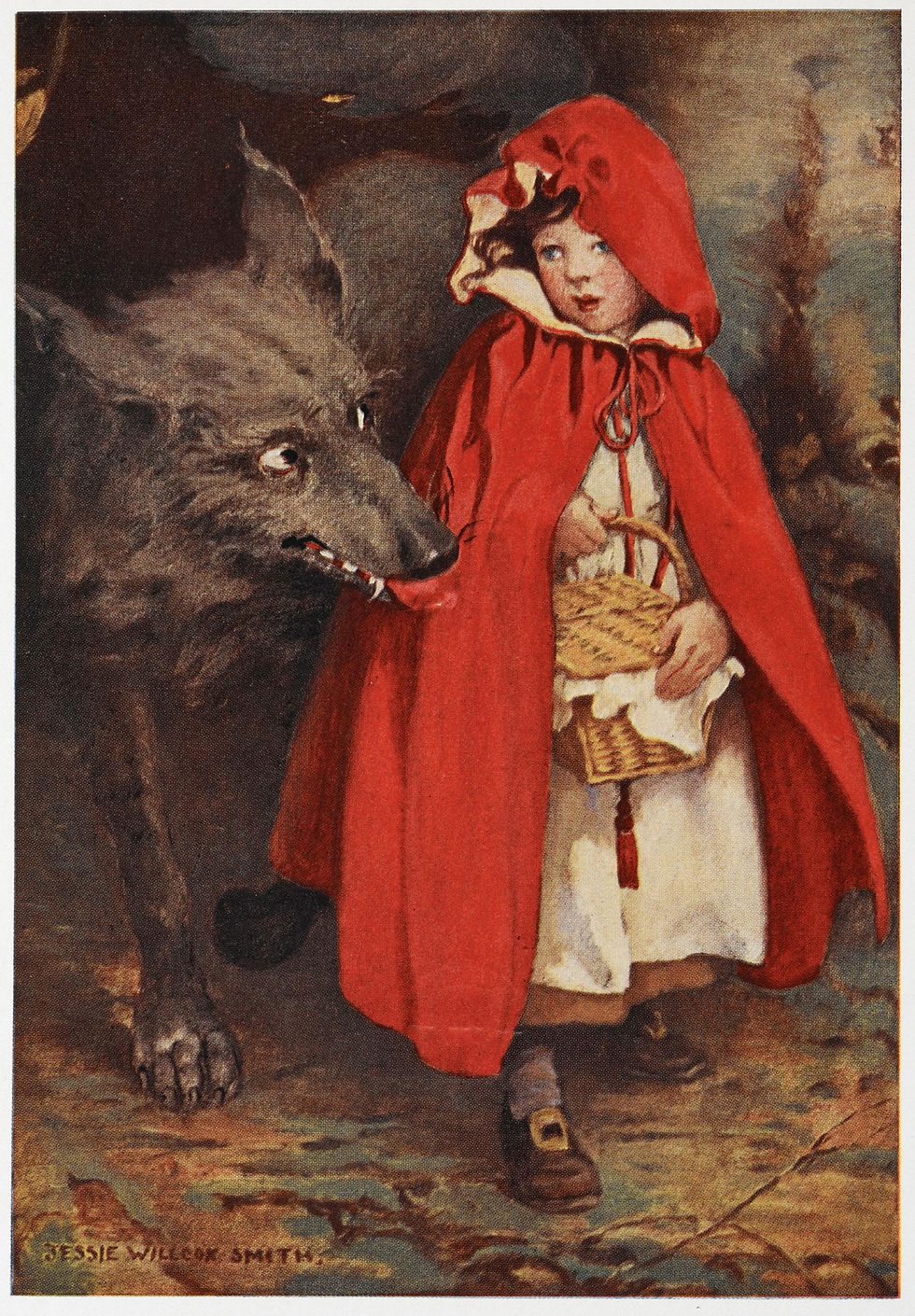
My work has always been somewhat dark, yet masked with a pretty visual, almost dreamlike, wistful or melancholic. I think this is why I am so drawn to fairytales. They too are often full of beautiful things, magic, gorgeous illustrations and nature, but more often than not there is a foreboding, warning and fear within them. I often use my work to explore some of the sadness in my life, an outlet for me to talk about my feelings without having to worry about words and getting frustrated at the fact that I cannot articulate myself properly.
I feel as though while my style has changed somewhat in the visual sense, mainly that my shapes, lines and readability have improved, I think that the biggest change is that now my pieces have a stronger purpose. My voice has grown because my work now has direction and meaning. It is no longer just about assembling images in an interesting way that somewhat conveys a feeling; it is about using those images to communicate, reflect, and understand myself more deeply.
In that sense, my artistic voice has become clearer over time: a blend of beauty and unease, of fairytale softness and emotional honesty, shaped by a trust in my work to speak for me.

Comments